Editor’s note: This essay was originally written for DWeb Camp 2026: Root Systems, a five-day gathering outside Berlin for builders and dreamers working toward a more decentralized internet - one that is private, resilient, less dependent on centralized platforms and infrastructure, and gives people and communities greater control over their data and technologies.
Inspired by the networks of roots and mycelium beneath a forest, this year's gathering invited participants to consider how decentralized technologies might behave more like living ecosystems: distributed, collaborative, adaptive, and resilient. Writing for this community, Awana Digital's Luandro asks us to look more closely at the forest itself - and at the Indigenous peoples whose knowledge, relationships, and systems of governance have sustained these living territories for generations.
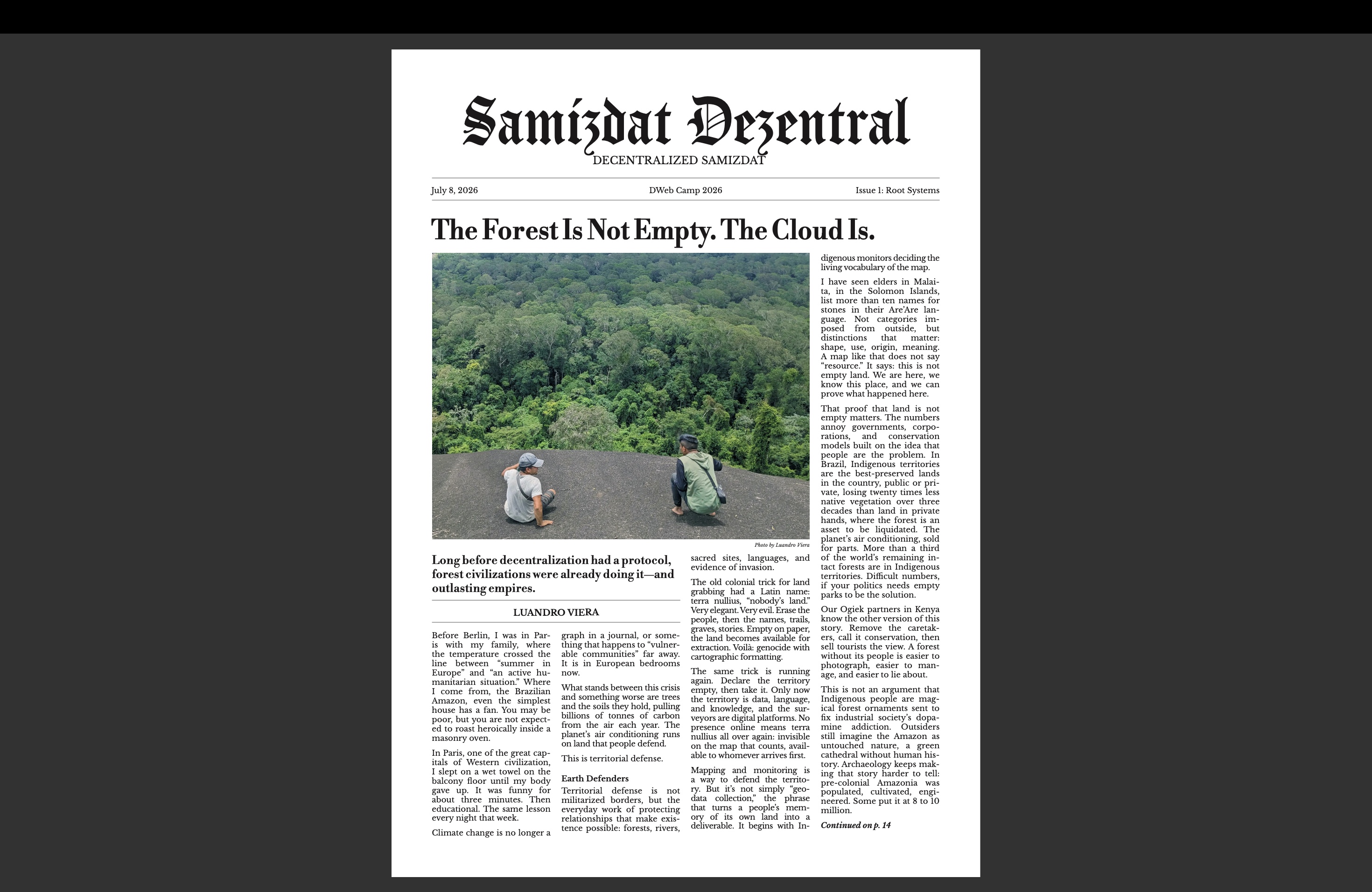
Before Berlin, I was in Paris with my family, where the temperature crossed the line between “summer in Europe” and “an active humanitarian situation.” Where I come from, the Brazilian Amazon, even the simplest house has a fan. You may be poor, but you are not expected to roast heroically inside a masonry oven.
In Paris, one of the great capitals of Western civilization, I slept on a wet towel on the balcony floor until my body gave up. It was funny for about three minutes. Then educational. The same lesson every night that week.
Climate change is no longer a graph in a journal, or something that happens to “vulnerable communities” far away. It is in European bedrooms now.
What stands between this crisis and something worse are trees and the soils they hold, pulling billions of tonnes of carbon from the air each year. The planet’s air conditioning runs on land that people defend.
This is territorial defense.
Earth Defenders
Territorial defense is not militarized borders, but the everyday work of protecting the relationships that make existence possible: forests, rivers, sacred sites, languages, and evidence of invasion.
The old colonial trick for land grabbing had a Latin name: terra nullius, “nobody’s land.” Very elegant. Very evil. Erase the people, then the names, trails, graves, stories. Empty on paper, the land becomes available for extraction. Voilà: genocide with cartographic formatting.
The same trick is running again. Declare the territory empty, then take it. Only now the territory is data, language, and knowledge, and the surveyors are digital platforms. No presence online means terra nullius all over again: invisible on the map that counts, available to whomever arrives first.
Mapping and monitoring is a way to defend the territory. But it’s not simply “geodata collection,” the phrase that turns a people’s memory of its own land into a deliverable. It begins with Indigenous monitors deciding the living vocabulary of the map.
I have seen elders in Malaita, in the Solomon Islands, list more than ten names for stones in their Are’Are language. Not categories imposed from outside, but distinctions that matter: shape, use, origin, meaning. A map like that does not say “resource.” It says: this is not empty land. We are here, we know this place, and we can prove what happened here.
That proof that land is not empty matters. The numbers annoy governments, corporations, and conservation models built on the idea that people are the problem. In Brazil, Indigenous territories are the best-preserved lands in the country, public or private, losing twenty times less native vegetation over three decades than land in private hands, where the forest is an asset to be liquidated. The planet’s air conditioning, sold for parts. More than a third of the world’s remaining intact forests are in Indigenous territories. Difficult numbers, if your politics needs empty parks to be the solution.
Our Ogiek partners in Kenya know the other version of this story. Remove the caretakers, call it conservation, then sell tourists the view. A forest without its people is easier to photograph, easier to manage, and easier to lie about.
This is not an argument that Indigenous people are magical forest ornaments sent to fix industrial society’s dopamine addiction. Outsiders still imagine the Amazon as untouched nature, a green cathedral without human history. Archaeology keeps making that story harder to tell: pre-colonial Amazonia was populated, cultivated, engineered. Some put it at 8 to 10 million. They shaped the land with roads, settlements, managed forests, and terra preta, an extraordinary technology that turned sand into fertile dark earth.
The Amazon’s monument is not stone. It is a cultivated forest that still feeds people, built with no emperor and no capital, its power spread across villages, kin, and shamans rather than piled at the top. Across much of Amazonia, complexity grew sideways, not up.
That should embarrass us. Our civilization builds pyramids of extraction: billionaires racing to Mars, datacenters drinking rivers, doomsday bunkers, fortunes too large to spend. Monuments to men who broke the world and would rather leave than put energy into fixing it.
The Toolkit
In my work at Awana Digital in Brazil, we work with CoMapeo, a peer-to-peer mapping app for Indigenous data sovereignty: offline maps sync phone to phone, with no tower or Silicon Valley datacenter in the middle.
In 2019, a map like this ended up in an Ecuadorian courtroom. The government had drawn the Waorani’s forest as Block 22, an oil concession ready for auction: empty ground, waiting for a buyer. The Waorani had spent years mapping the same place their own way, with tools we built together: rivers, hunting trails, sacred sites, ancestral graves, a territory full of life. The court ruled the government had never properly consulted the Waorani people, suspended the auction, and kept half a million acres of rainforest out of the drills.
The empty block turned out to be a homeland, and the proof held up in court.
But territorial data can be dangerous. A sacred site, patrol route, medicinal plant: information that protects can also expose. The question is not as simple as how to make everything public; we must consider who decides what leaves, who reads it, and what should never become data at all.
Now AI has arrived, wearing the usual costume: inevitable, revolutionary, and owned by a handful of men who cannot agree whether they have built the savior of humanity, the Terminator, or a very expensive autocomplete.
The harms did not begin with AI. Phones, social media, and platform dependency were already pulling young people toward colonial languages, addiction, and Western ways of life. AI accelerates this.
A teenager opens a phone and the whole machine speaks Portuguese, English, TikTok, church, capitalism, Google. Dopamine, dopamine, dopamine. Slowly their own language becomes something for grandparents, ceremonies, jokes, and scolding. Then AI arrives: do not worry, we will save it for you.
Thank you, white savior, but we have seen this movie.
The Empty Cloud
Of roughly 7,000 languages, only a small fraction has a meaningful digital presence. A language still falls silent about every two weeks. Forest and ceremonial knowledge, carried in song, practice, and relationship, become invisible to machines that then claim to know the world.
None of this is folklore. It is technology the West is still reverse-engineering, when it manages to at all. The cloud calls itself the sum of human knowledge. Most of it was never uploaded.
So why touch these tools at all?
Because they are already touching us.
No community needed AI to be productive or modern. But colonization now arrives through satellites, databases, platforms, and language models. The goal is not Big Tech “including” Indigenous languages. The goal is autonomy: communities owning their data, models, servers, and decisions, speaking their languages without being extracted. Our job is not to become indispensable, but to support Indigenous people as they build technology themselves.
While you are reading this in the German countryside, surrounded by people who can explain data conflict resolution protocols before breakfast, here is my modest proposal: judge decentralization by what is left when the laptops close.
The web did not stay centralized for technical reasons; the protocols have existed for years. It stayed centralized because of power, land, and capital. Decentralize those, and the web follows. We have been solving the easy part.
The decentralized web should not arrive as a missionary with better protocols. It should arrive humble enough to notice that real decentralization already exists: in forests, languages, kinship systems, elders, and territories that survived empires sent to erase them.
Digital technology was always the small part. The real technology is the culture that cultivated these forests and kept them alive for time untold.